
Your Brain & Your Money
The Investor’s Brain: Who Is Holding the Reins?
Over the last several years, I’ve become increasingly fascinated by something that has very little to do with P/E ratios, charts, earnings, or interest rates:
The brain of the investor
There is actually a field devoted to this intersection called neurofinance the study of how our brains, emotions, reward systems, and stress responses influence financial decision-making.
And the more I study it, the more convinced I become that understanding our own brains may be every bit as important as understanding the markets.
And when I say our brains, I don't just mean yours. I mean mine, too. As an investment advisor, I think that's important to acknowledge. Our industry spends a great deal of time talking about investor behavior, fear, greed, panic selling, chasing returns, FOMO. What we don't talk about nearly as often is the person on the other side of the desk making investment decisions on behalf of clients.
Advisors aren't immune to these forces because we have training, experience, or letters after our names. We're human.
In some ways, managing other people's money can actually increase the emotional stakes. There's the responsibility of protecting someone's savings, the desire to perform well for them, the discomfort of seeing an account decline, and the temptation to react when perhaps the better decision is to wait. I believe acknowledging that is a strength, not a weakness.
Plato Understood This 2,000 Years Ago
Long before neuroscience, Plato described the human mind through the metaphor of a chariot pulled by two horses. The charioteer represents reason, awareness, and choice.
One horse pulls toward our higher values: discipline, courage, patience, and doing what we know is right.
The other is unruly. It represents impulse, desire, fear, and urgency.
And the goal isn't to eliminate the unruly horse. It's learning to hold the reins.
When I first applied this metaphor to investing, it felt almost perfect. Imagine a market falling quickly. One horse says: Protect them. Sell. Do something.
The other says: Follow the process. Assess the evidence. Don't let fear make the decision.
Now imagine a market that's soaring. We're making money. Buy more. Don't miss this.
Versus: Stay disciplined. Position size matters. Risk still exists.
That's neurofinance in action.
The Market Doesn't Just Move Our Money
Our brains evolved to avoid pain, seek rewards, detect threats, and respond quickly to uncertainty. And if you invest for yourself you know, financial markets push virtually every one of those buttons.
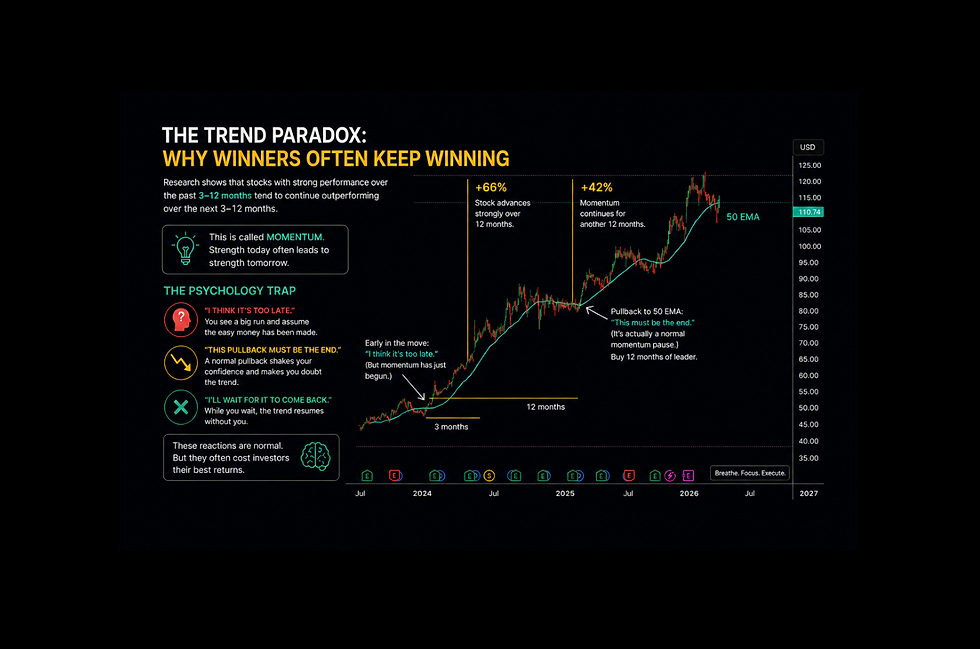
Losses can trigger fear and urgency. Gains can stimulate reward-seeking and overconfidence. Volatility can make us crave certainty precisely when certainty doesn't exist.
So I've learned to ask myself two questions: What is the market doing?
And equally important: What is the market doing to me?
That second question isn't something I was taught when I began investing. But today, as an advisor, I consider it part of risk management.
Risk management isn't only deciding how much of a position to own, where to exit, or how much cash to hold. It's also creating enough space between an emotional response and an investment decision.
Why I'm Sharing This With You
This subject has also become the basis of my upcoming presentation at The MoneyShow in Las Vegas, February 2027. Trading Yourself: Emotional Regulation Is Your Greatest Edge.
I won't pretend that experience makes me immune to fear, frustration, excitement, ego, or the desire to act. Instead, I want to recognize those forces, build systems around them, and continually improve my ability to make decisions from process rather than emotion.
Every trade is actually two trades.
The first is with yourself. The second is with the market.
If you lose the first one, the second becomes much harder to win.


Comments